Building a POCUS QA Programme That Scales
POCUS quality assurance programmes regularly fail to be implemented consistently. This is what it takes to build a scalable one that survives.
First, separate QA from overread
The most common design error is building a QA programme that is really a shadow radiology service.
Joshua Guttman, an emergency physician at Emory University, draws the distinction cleanly. An overread is a diagnostic final read, typically by radiology, and it carries responsibility for the clinical interpretation. POCUS QA reviews image quality and interpretation accuracy over time, for education and credentialing, and it does not replace the bedside clinician’s interpretation (Peachtree POCUS).
In POCUS the scanning clinician, or the attending supervising a trainee, owns the interpretation. As Guttman puts it, “QA supports that responsibility; it doesn’t assume it. QA exists to improve skills and ensure safe practice, not to provide a second read on every exam.” Routine overreads are not required for POCUS.
Getting this wrong is expensive. Build QA as an overread service and you have created a radiology workload nobody funded. Treat it as purely educational and you have no mechanism for the review that does find something clinically important.
What a review should actually look at
- Image acquisition. Was the study technically adequate?
- Interpretation. Was the conclusion supported by the images?
- Recognition of limitations. Did the clinician appropriately identify a nondiagnostic study?
The third is easy to leave out, however is an important safety behaviour. A clinician who recognises that their images will not answer the question, and says so, has performed well; a scoring system that rewards only diagnostic studies teaches the opposite.
There is no mandated form. ACEP standards provide a workable structure, and many programmes use a five-point scale on which 3 means the images are diagnostic. A clinician consistently below that threshold needs support and education rather than a lower score.
Who should perform QA
Not whoever has capacity. Guttman is direct: reviewers should ideally have advanced POCUS training such as a fellowship or dedicated preceptorship, or substantial experience and a strong institutional reputation for high-quality POCUS work. The reviewer “should be someone the team trusts as a clinical and educational resource, not simply the person who had time to do it.”
If nobody in the practice is at that level yet, build it: fund external training for a clinician, arrange mentorship with an experienced outside reviewer, or buy external QA oversight while internal skills develop.
External review is a bridge, not a destination, and the pricing shows why. Peachtree POCUS offers expert image review with feedback on acquisition and interpretation at around $25 per scan, falling to roughly $15 at volume. At 200 reviews a year that is cheaper than carving out consultant time. At 2,000 the arithmetic reverses, because the cost scales with exactly the thing that is growing.
QA needs time, not only skill
QA programmes usually lapse because nobody was given the hours. Reviewers need protected administrative time, ideally with administrative support so the process is streamlined rather than a burden. Without dedicated paid or protected time, QA often doesn’t happen consistently, or at all.
The lever for securing QA time already exists in most hospitals: FPPE and OPPE requirements support allocating resources for ongoing evaluation, which makes them the natural argument when a POCUS lead asks for staffing. For a published floor, the Emergency Ultrasound Fellowship Accreditation Council specifies a minimum of 0.2 FTE of salary support or protected time for ultrasound fellowship directors, though that is a US emergency medicine fellowship standard rather than a general benchmark.
How much to review
Guidance depends on where the clinician is:
- Not yet credentialed: review 100% of scans.
- Credentialed: 5% to 10% is reasonable, per ACEP guidance.
Programmes often review more intensively early and scale down as skills stabilise.
Timeliness beats completeness
QA feedback needs to arrive while the case is still fresh in the clinician’s mind. No guideline defines “timely”, and resources differ: some departments review daily, others weekly.
Guttman’s formulation is the one to design around: aim for meaningful turnaround, not perfection. “A program reviewing all scans daily is great, but a program reviewing scans consistently every week is far better than one aiming for daily review and achieving none.”
The same logic applies to the percentage. A stated 10% that is consistently met is worth more than a stated 25% that runs at 8%.
Prompt feedback lets a clinician connect the images, the case and the learning point. Arriving weeks later, the teaching moment is gone, and a significant misinterpretation that might still have been actionable no longer is.
Make it supportive, not punitive
Programme culture determines whether QA survives. It should feel routine, expected and supportive: everyone improves with feedback, including experienced clinicians. Where someone is struggling, the response is supervised scanning, targeted teaching or a refresher rather than sanction, and actionable written comments move people forward faster than numbers alone.
Use tooling built for it
Consistent QA depends on infrastructure. Guttman’s assessment of the alternative is worth quoting in full, because most departments start there: “Can QA be done using shared drives and spreadsheets? Technically, yes. Practically, no. Manual systems are clunky, time-consuming, and eventually fall apart.” Three fields have to be captured at the point of scan or the whole thing runs by hand: an operator identifier, a clinical versus educational designation, and the exam type. None can be reconstructed reliably afterwards, and without them reviews cannot be routed, educational scans clog the clinical queue, and credentialing tallies have to be counted manually.
How ePOCUS supports this
Everything above describes what a QA programme has to do. This is how ePOCUS does it, against the same four problems: who reviews, how much gets reviewed, how feedback reaches the clinician, and how credentialing gets counted.
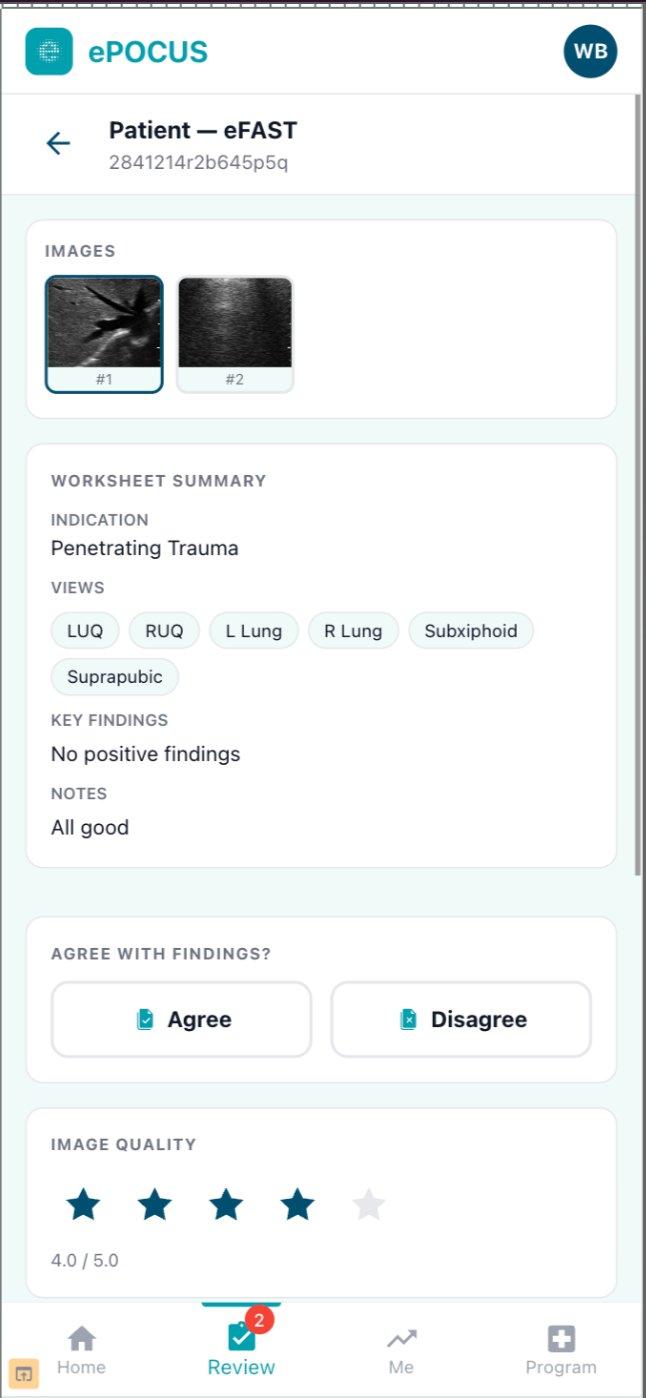
Review a specialist can do from anywhere
A reviewer opens the study and sees the images alongside the worksheet the scanning clinician completed: indication, the views obtained, key findings and any notes. They then do two things. They record whether they agree or disagree with the findings, which is the interpretation dimension. And they score image quality out of five, which is the acquisition dimension, on the same scale most programmes already use and where three means the images are diagnostic.
Because review happens remotely, the reviewer does not have to be someone in your department who happened to have a free hour. That is the practical answer to the expertise problem set out above: a small programme can route studies to a specialist with fellowship-level POCUS training without employing one.
A review percentage you set once
Programme leads can auto-assign a percentage of scans for review rather than relying on anyone remembering to pull a sample.
That turns the target from a stated intention into a setting. A department running ACEP’s 5% to 10% for credentialed clinicians and 100% for those still working toward credentialing configures both once, and the queue fills itself. It also removes the triage step that consumes most avoidable reviewer time, because studies arrive already attributed to an operator and classified by exam type.
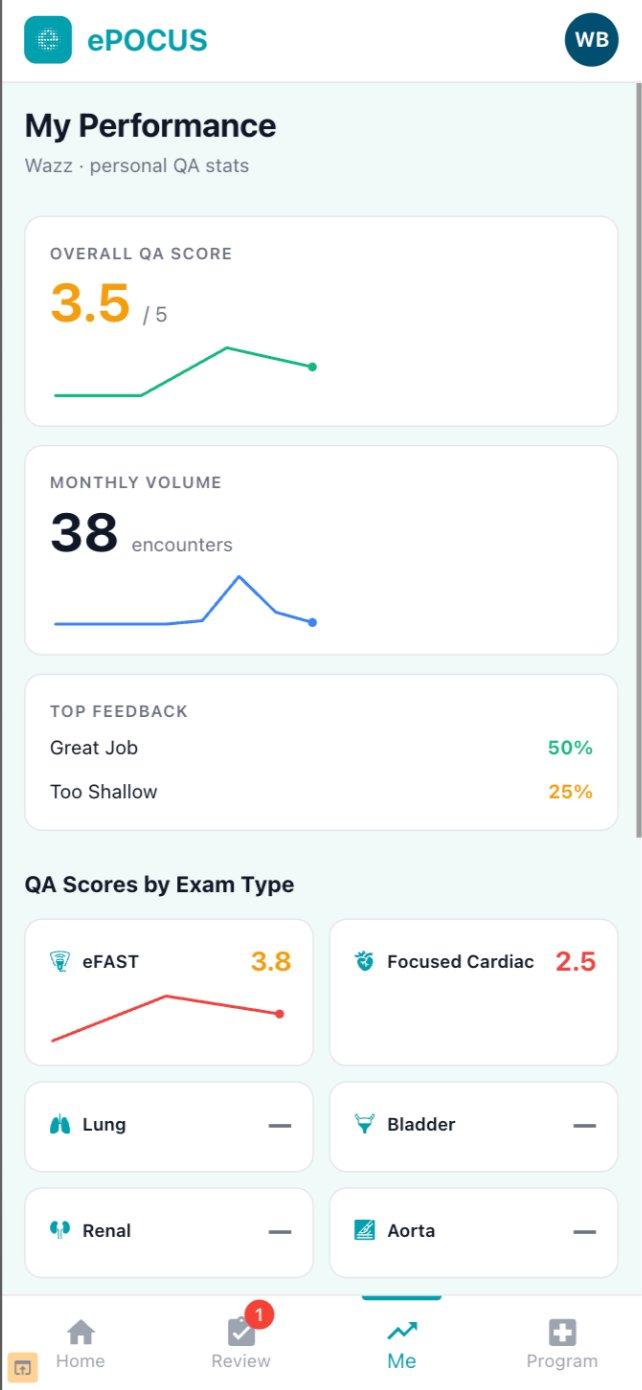
Feedback the clinician sees
Each clinician has their own view: an overall QA score with its trend, monthly volume, the feedback themes appearing most often in their reviews, and scores broken down by exam type.
That last breakdown does something the aggregate cannot. A clinician scoring 3.8 on eFAST and 2.5 on focused cardiac does not have a POCUS problem, they have a cardiac problem, and the remediation is a cardiac refresher rather than a general one. It also makes the application-specific nature of competence visible to the clinician themselves, which is the point at which QA stops feeling like surveillance and starts being useful.
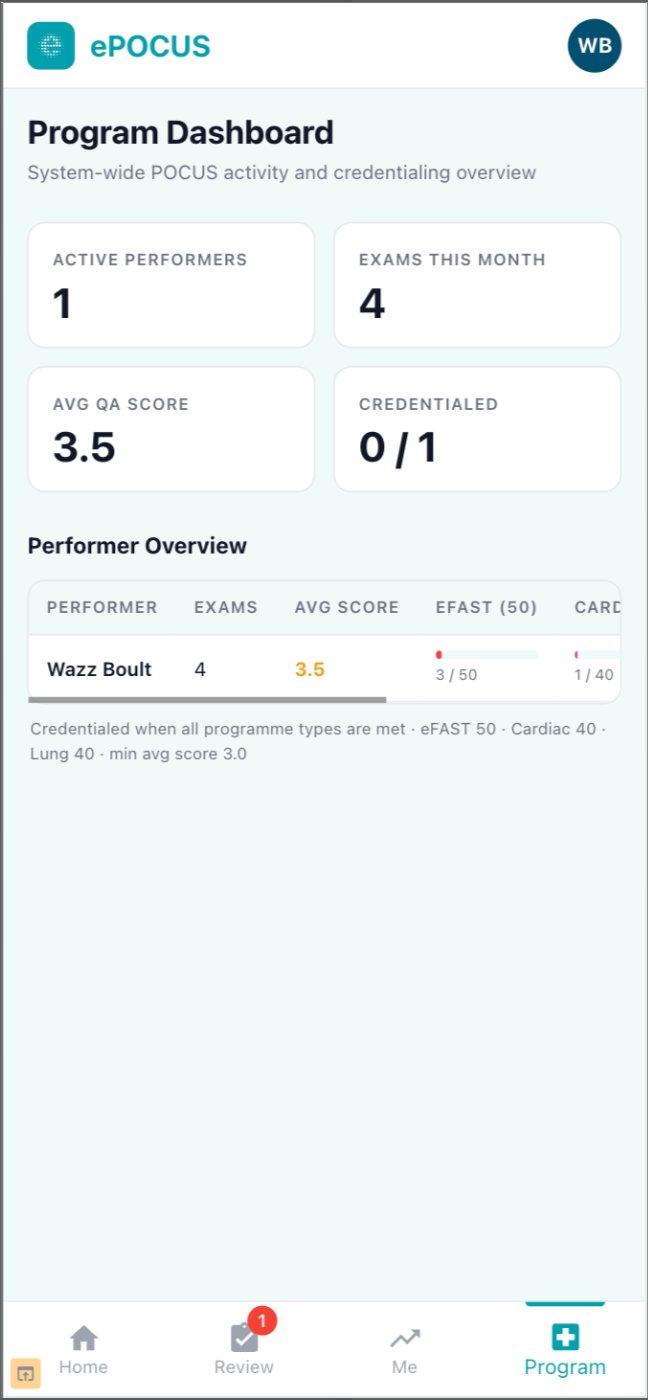
Credentialing that counts itself
The programme dashboard shows active performers, exams this month, average QA score and how many clinicians are credentialed, then breaks it down per clinician with progress against each application’s threshold.
The thresholds are configurable, and the screen above shows a programme requiring 50 eFAST, 40 cardiac and 40 lung studies at a minimum average score of 3.0. Credits accrue as reviewed scans come in, so progression is continuous rather than something an administrator reconstructs from a spreadsheet at appraisal time.
This is also what turns credentialing from an administrative backlog into a retention tool. Health workers can see a defined path beyond their initial training, and the programme can see who is close to the threshold and who has stalled.
For why this is becoming more pressing rather than less, see why POCUS quality assurance matters.
ePOCUS attaches the operator, the designation and the interpretation to every study before it reaches the review queue. See it in your own workflow.